
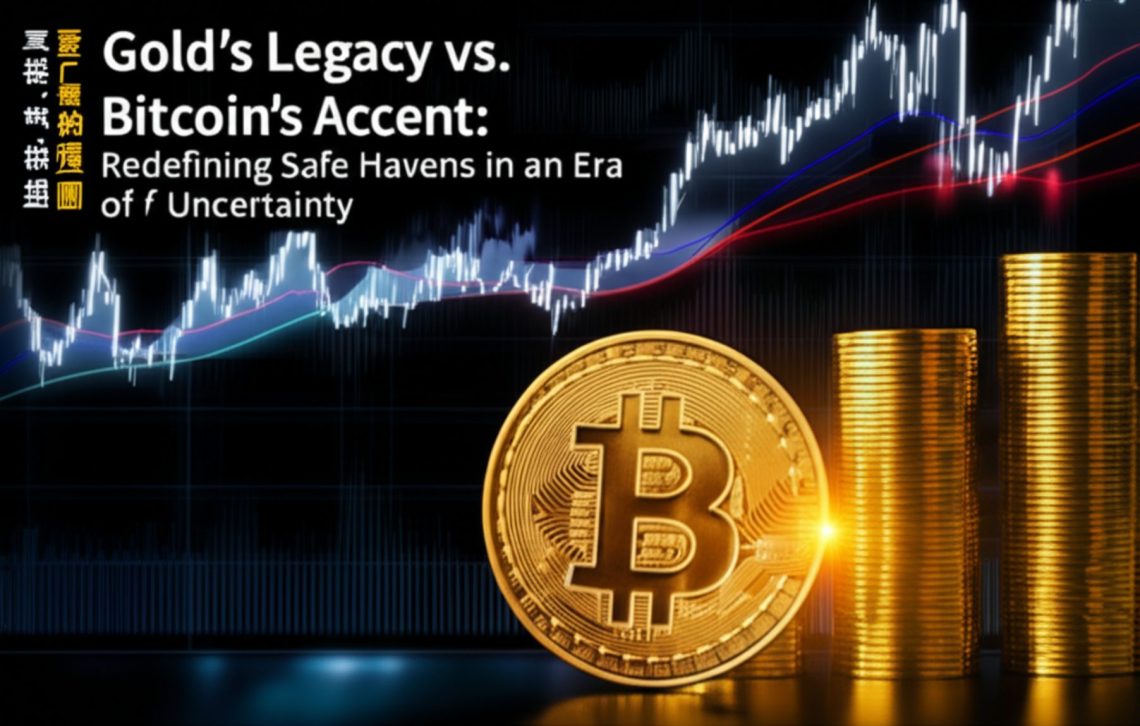
Gold’s Legacy vs. Bitcoin’s Ascent: Redefining Safe Havens in an Era of Uncertainty
In the turbulent theater of global finance, investors find themselves spectators to a defining duel. On one side stands gold, the ancient sentinel of wealth, its luster undimmed by millennia of crises. On the other is Bitcoin, the digital upstart, a volatile yet compelling vision of a decentralized future. This is more than a simple asset allocation choice; it is a referendum on what we trust to preserve value amidst looming inflation, geopolitical tremors, and the shifting sands of monetary policy. The decision reflects a fundamental split in ideology, pitting the tangible history of physical metal against the immutable logic of cryptographic code.
The case for gold is a story of enduring trust. It serves as the world’s ultimate financial anchor when confidence in governments and their currencies wanes. Central banks, in a clear signal of de-dollarization and risk mitigation, are accumulating physical gold at a record pace. This precious metal isn’t a speculative play for quick gains; it is a long-term instrument of capital preservation. Its value is not derived from market hype or technological promise, but from its universally accepted role as a final bulwark against systemic risk, a tangible piece of security in an intangible world.
Bitcoin’s narrative, however, is far more complex than its “digital gold” moniker suggests. Recent market data reveals a growing correlation with high-growth technology stocks, behaving less like a safe haven and more like a risk-on asset that thrives in periods of market optimism. When political uncertainty, such as a government shutdown, resolves, Bitcoin surges alongside equities. Yet, its core appeal remains potent: a mathematically guaranteed scarcity with a supply cap of 21 million coins and a network secured by decentralized consensus. Investing in Bitcoin is less a hedge against short-term volatility and more a profound bet on the architectural rewiring of the global financial system.
The immediate future of this rivalry will be decided on the macroeconomic battlefield. Political events, like the recent resolution to a US government shutdown, have an immediate impact, boosting risk assets and temporarily aligning the fortunes of both stocks and crypto. As the focus shifts from political drama back to hard economic data—inflation reports, employment figures, and central bank actions—the divergence will become clearer. An environment of falling interest rates and quantitative easing could propel Bitcoin to new heights, while persistent instability and a flight to safety would likely burnish gold’s appeal. Regulatory winds, particularly from a US administration promising to foster a crypto-centric economy, will also serve as a powerful, unpredictable catalyst.
Perhaps the most critical oversight in this binary debate is the evolution happening within the Bitcoin ecosystem itself. The discussion is no longer just about a static store of value. Innovations like Layer 2 protocols are emerging, aiming to transform Bitcoin from a passive asset into a dynamic foundation for smart contracts, DeFi, and high-speed payments. This evolution introduces a new dimension to the debate: utility. While gold represents value at rest, an evolving Bitcoin ecosystem promises value in motion, creating a functional, programmable asset class that seeks to do more than just sit in a vault.
Ultimately, the question of gold versus Bitcoin is not about picking a definitive winner for the next decade. Instead, it compels us to construct a more resilient and forward-looking portfolio. Gold remains the unparalleled insurance policy, a hedge against the catastrophic failures of the old guard. Bitcoin, along with its burgeoning ecosystem, represents a calculated stake in a radically different future, an engine of potential growth fueled by technological disruption. The truly modern investor must therefore move beyond the “either/or” fallacy and ask a more nuanced question: how do I balance the timeless security of history with a strategic position on the frontier of innovation?

傑西
If you want to increase your IQ, EQ, and financial intelligence, be sure to subscribe to our website! The content on our website will help you improve yourself. Imagine yourself leveling up in a game, making yourself stronger!If you find this article helpful for you or your loved ones, please share it with others so that more people can benefit from it!


